The Pest Department in My Skull
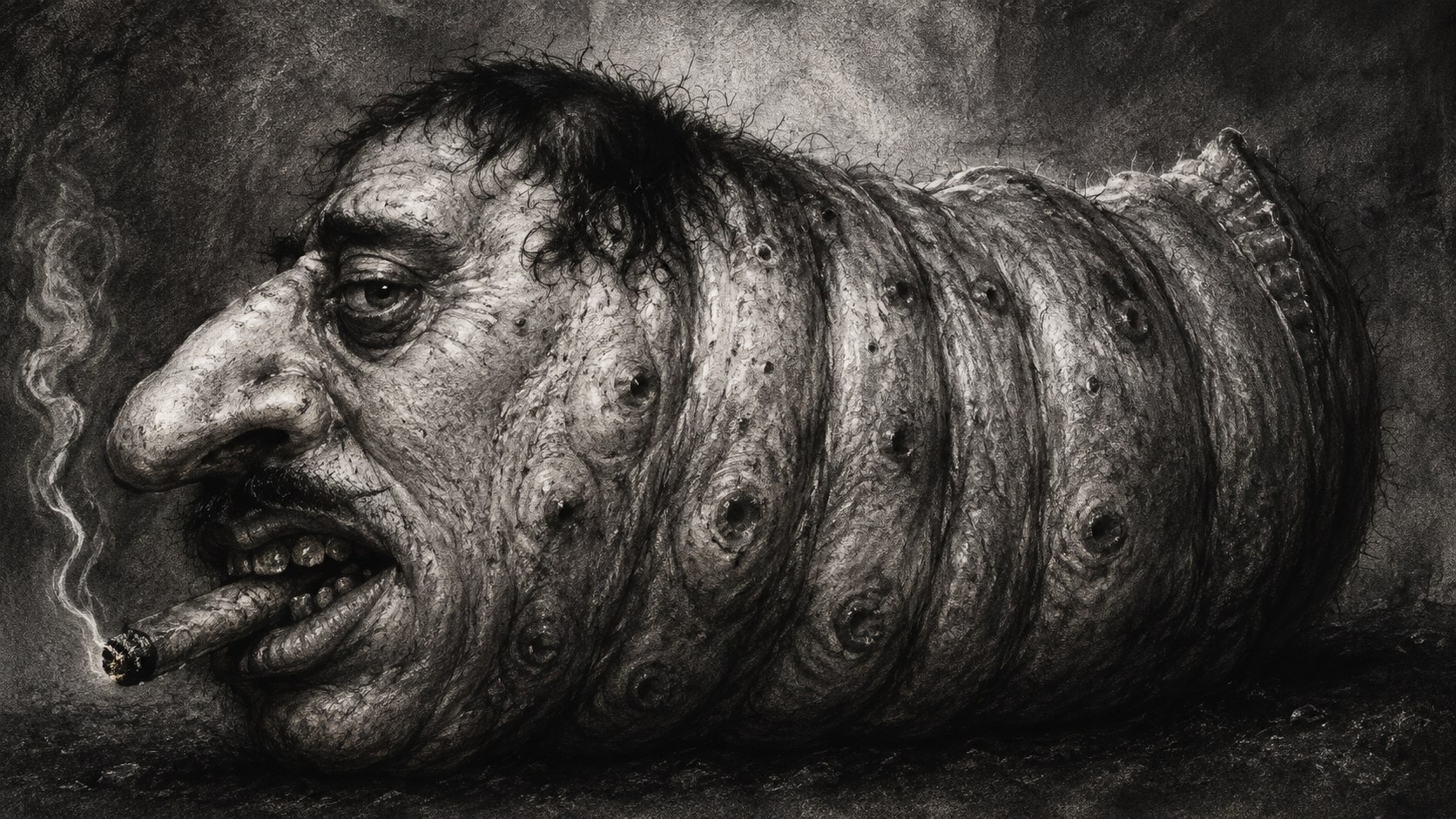
Acronyms and notes:
E. coli — Escherichia coli, a common bacterium often used as a familiar example in biology because it can multiply quickly under the right conditions.
A cockroach has one advantage over human beings. It does not pretend to be improving the nation.
It simply appears near the tea pan at eleven-thirty at night, brown, polished, ancient, and horribly confident, as if it has inherited the kitchen from a grandfather who knew the landlord. Its antennae move with official seriousness. Left, right, pause. One almost expects it to ask for my Aadhaar card.
I stand there in cheap shorts, stomach hanging like a tired protest banner, holding a slipper and wondering the small poisonous question: is this only a cockroach, or has my brain again started turning certain human beings into insects?
This is not a proud thought.
It is not even a decent thought.
But a middle-aged Bengali man living alone on the edge of Calcutta, surviving on consulting work, tea, bad sleep, and the occasional miracle of the rice cooker, develops a private vocabulary. Mine has a few respectable words in it. It also has one dangerous word.
Pest.
Calling a person a pest is bad biology. It is probably bad English too. No biologist in a neat laboratory coat says, “Here we see the common form-blocking uncle, found mainly near counters, queues, and government windows.” Pest is not a species. It is not a family. It is not a proud branch of the tree of life.
Pest is a human complaint wearing a science cap.
A rat in a field is wildlife. A rat in your rice tin is a pest. A fungus in the soil is ecology. A fungus on your toe becomes a tiny landlord with damp walls. A mosquito over a pond belongs to nature. A mosquito near your ear at 2:13 in the morning is a personal insult delivered by air.
So yes, I know the word is slippery.
That has not stopped me.
Since returning to India, I have sometimes used it inside my head. Secretly. Unofficially. Without parliamentary approval. Not for any caste, religion, language, class, region, gender, or any of the large filthy labels mobs use when they want to dress cruelty as philosophy. No. I mean the behavioral pest.
The queue-cutter.
The smiling liar.
The form-blocker.
The man who says “come tomorrow” with the peaceful face of someone who has just strangled tomorrow behind a curtain.
The small office gatekeeper who has no real power, so he rubs his two grams of authority on your face like cheap aftershave.
The para committee hero who thinks the building noticeboard is the Constitution.
The driver who parks diagonally in a lane already thinner than a hungry snake, then looks offended when physics complains.
You know this person. You may have met him near a bank counter, a clinic desk, a housing office, a school admission room, a cable connection complaint, a police booth, a train queue, a pharmacy, a puja subscription table, or that mysterious Indian institution called “Sir, just wait five minutes,” where five minutes means anything between seven minutes and the decline of civilization.
Still, biology clears its throat.
Biology says, listen, sweating philosopher, a pest is not what a creature is. A pest is what happens when a creature enters your arrangement and starts damaging it. The cockroach is not morally corrupt. It is simply good at surviving in our crumbs. The mosquito is not personally ambitious. It merely discovers our stagnant water. The rat does not hate us. It appreciates our grain storage.
The pest is often the bill for how we live.
This is where the slipper in my hand becomes less confident.
Because if I call a person a pest, I may be noticing a real behavior. But I may also be hiding a larger failure behind a smaller insult. Scarcity. Bad design. Fear. Bribery. Delay. Weak rules. Strong egos. Broken drains. Broken offices. Broken patience. A whole country where every small transaction can become a wrestling match in a public toilet.
The man at the counter may be underpaid. The guard may have been shouted at by three bigger bullies before I arrived. The clerk may be trapped in a system where obstruction is job security. The neighbor may be lonely. The driver may be one rent payment away from disaster. The liar may have learned lying because truth here often walks around barefoot and gets slapped.
Fine.
Accepted.
Stamped.
Filed.
Then the same fellow smiles and says the exact opposite of what he said yesterday, while pretending my memory is a defective ceiling fan.
At that moment, compassion goes out for tea and does not return.
This is the real danger. Not the cockroach. The repetition.
One irritation is an incident. Ten irritations become weather. After a hundred, you stop seeing people and start seeing patterns wearing sandals. The mind, which should be a thoughtful instrument, becomes a cheap sorting machine: useful, tolerable, risky, nuisance, pest.
That is not wisdom.
That is exhaustion with a clipboard.
And exhaustion is a terrible philosopher. It has confidence, but no manners. It takes one bad morning, adds humidity, poor sleep, a cancelled payment, toothache, a neighbour drilling into concrete, two political slogans from loudspeakers, one news debate where everyone shouts like a goat market, and suddenly the brain says, “I have understood society.”
No, it has not.
It has merely run out of glucose.
Still, words breed. E. coli can multiply quickly in warm broth when conditions are right. A word can do the same inside the skull. Give it heat, insult, loneliness, bureaucracy, and three nights of broken sleep, and soon “pest” is no longer a word. It is a colony.
The petri dish fogs over.
You look inside and find your own face growing moral fungus.
This is why metaphors must be kept on a leash. They begin as lamps and end as police vans. A good metaphor says, “Look, this is like that.” A bad metaphor says, “This is that, now bring the spray.”
The British understood this very well, unfortunately. Empire loved categories because categories are cages that attended school. It could look at a continent full of languages, food, rivers, songs, illnesses, famines, quarrels, jokes, and genius, and produce a file in which living people became a sanitation problem with eyebrows.
And here I am, brown, educated, irritable, and supposedly modern, trying not to become a tiny colonial officer inside my own head.
Stamp.
Stamp.
Stamp.
PEST.
No. That way lies ugliness.
But I will not lie either. Some human behavior is pest-like. Not human essence. Behavior. The repeated nibbling of public life. The little theft of time. The casual lie. The love of obstruction. The pleasure some people take in making another person small for ten seconds because those ten seconds are the only kingdom they possess.
That is the thing I am naming.
Carefully.
With tongs.
On a normal day, after tea and two biscuits, I can make this distinction. Behavior, not being. Pattern, not person. Action, not soul. But by evening, when the electricity flickers and the room smells of hot wire, old books, damp cloth, and my own defeated armpits, the distinction becomes thin.
A real ant crosses the floor with a crumb. Heroic little fellow. Six legs, no manifesto, no fraud, no WhatsApp university degree. It is not a pest until it reaches my sugar.
That is the whole matter, almost.
The ant becomes pest when it enters my sugar. I become uncivilized when someone enters my patience.
So perhaps the honest thing is not to pretend I am above the word. I am not. The honest thing is to keep the word in a jar and label it properly.
Label: Pest Metaphor.
Habitat: Middle-aged male resentment.
Diet: Delay, dishonesty, humidity, unpaid invoices, bureaucratic theatre, and poor sleep.
Danger: May dehumanize the user before use.
And beside it, another jar.
Label: User.
Condition: Irritable, lonely, morally inconsistent.
Notes: Frequently mistakes exhaustion for insight.
The cockroach near the tea pan finally moves. I lift the slipper with the dignity of a failed philosopher preparing to restore order to the republic. It pauses under the kitchen light, antennae trembling, perhaps studying me as I study it.
Two creatures in a rented room.
Each convinced the other is the real problem.
Then it escapes under the rice cooker, smug as a minister after an inquiry, and I stand there barefoot, breathing hard, holding a slipper like a constitution nobody reads.